
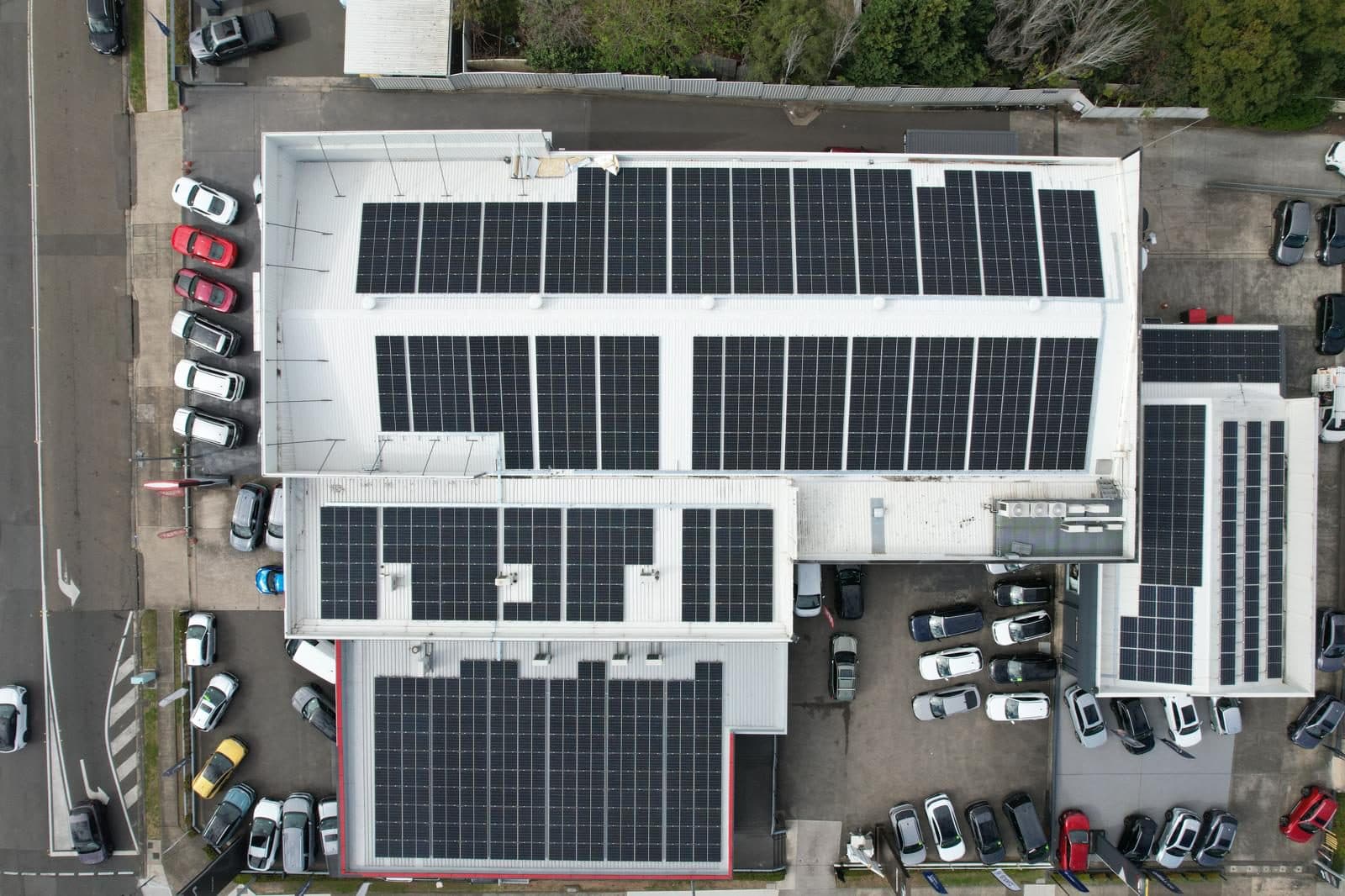
Put solar on your business's roof without spending any capital, buy the power it makes at a rate designed to reduce your overall electricity costs, and receive an upfront payment when it's switched on. That's the offer SIPENERGY and Agile Energy are running now.
Agile funds, owns and maintains the system. SIPENERGY designs and installs it. You buy the power it produces at a competitive rate, locked in under a long-term power purchase agreement with Agile, and your capital stays in the business where you need it.
As part of that agreement, Agile pays your business $100 for every kilowatt installed once the system is commissioned. A 200kW system is $20,000. A 500kW system is $50,000, and a 1,000kW system is $100,000.
Funded by Agile. Delivered by SIPENERGY.
Here's how it all works, start to finish.
The upfront payment
| System size | Upfront payment from Agile |
|---|---|
| 50 kW | $5,000 |
| 100 kW | $10,000 |
| 200 kW | $20,000 |
| 250 kW | $25,000 |
| 500 kW | $50,000 |
| 750 kW | $75,000 |
| 1,000 kW | $100,000 |
Agile pays it into your business's bank account when the system is commissioned. It isn't a credit note or a discount off a later bill, and it's yours to use wherever the business needs it. It's part of the power purchase agreement, so it's paid once the agreement is signed, the site has met Agile's qualification and credit approval, and the system is switched on.
If cash matters more to you than the rate does, that's a conversation worth having. Agile can make a larger upfront payment and recover it through a higher energy rate across the term. You pick the amount, the rate moves, and you see both numbers side by side before you commit to either.
Who owns what
Agile Energy pays for the system and owns it, which makes operating and maintaining it their job for the length of the term. SIPENERGY designs it, builds it and certifies it. The only thing you put in is roof space.
In return you buy the power the system makes, at a competitive long-term rate designed to reduce the site's overall electricity costs, locked in for the length of the term. Everything the roof doesn't cover, you keep buying from your retailer exactly as you do now.
That's a power purchase agreement, or PPA. The rate, the term and the upfront payment are all parts of the same agreement. You already buy electricity from someone. This changes where part of your electricity comes from, and commits you to buying what your roof produces for the term.
What you pay for the power
You pay for the electricity the system produces, at a rate set when you sign and held for the term. The rate follows the term you choose:
| Term | Rate | Suits |
|---|---|---|
| 15 years | 14.0c/kWh | Owner-occupiers going after the lowest rate available |
| 10 years | 17.0c/kWh | The balanced one. A strong rate on a commitment most boards will wear |
| 7 years | 20.0c/kWh | Shorter lease left to run, or you want the asset handed over sooner |
You don't put in capital, arrange finance or negotiate a maintenance contract. Monitoring, servicing, repairs and replacements sit with Agile, because Agile owns the equipment. If the system doesn't generate, you aren't invoiced for generation.
What a unit of electricity actually costs you
Your bill has a usage rate on it, in cents per kilowatt hour, and it's tempting to hold that number up against 14.0c and decide the gap isn't worth the trouble. It's the wrong number to compare.
The usage rate only covers the electricity itself, which is about 40% of a commercial bill. Another 40% or so is network charges, which is what you pay to have the power delivered to you down the poles and wires. The rest is environmental schemes and your retailer's own costs. The usage rate is the price of the goods. The rest of the bill is delivery and the charges that ride along with it.
You can shop around on the goods. You can't shop around on the delivery. Network charges are set by the network, not by your retailer, so switching providers or squeezing a better deal out of the one you've got leaves them exactly where they were, and whatever you do win gets repriced in a year or three.
Solar on your own roof comes at it differently. Every unit your panels make that your site uses is a unit you don't buy from the grid, which can reduce the variable network and other consumption-related charges associated with grid electricity, not just the energy charge. How much depends on your network tariff, including any demand or fixed charges, which solar may not change.
So the fair comparison for 14.0c isn't the usage rate on its own. It's the usage rate plus the other charges on your bill that rise and fall with the units you use. Send us a recent bill and we'll work that out for your site.
Who this works for
Agile's bar for this offer is tighter than a standard PPA:
- 50kW to 1,000kW system. 50kW is a firm floor, 100kW and up is preferred
- A daytime load. The value comes from using the power as it's generated
- Around $2,500 a month or more on electricity
- Usable roof or ground area, roughly 200m² and up
- Owner-occupier, or a lease with decent time left on it
- Commercial and industrial only
- Credit approval by Agile, as with any long-term agreement
Leasing your building changes who needs to sign, not whether it can happen. Where there's enough term left and the landlord's willing, these get done regularly, and a funded system is a much easier ask of a landlord than a request to spend their money.
If you already have panels up there, that's not a disqualifier either. Plenty of sites covered a fraction of the available roof five years ago and never went back to it. We can run a health check on what's installed to see whether it's still performing the way it should, and read your bills to work out whether you need more solar and how much more the roof will take. If the existing system is far enough past its best, taking it down can be included in the job of putting the new one up.
And if you'd rather just own it from day one, say so. We'll quote you a direct purchase instead. We do both, and the PPA isn't always the answer.
What the agreement commits you to
It isn't a loan. You're not borrowing money to buy an asset. You're buying the power an asset makes, the way you already buy power from a retailer, so there's no finance to arrange and no capital approval to go and win. How the agreement is treated in your accounts depends on your business, so it's worth running past your accountant.
What you are committing to is buying the energy the system produces for seven, ten or fifteen years. That commitment is what funds the system, its maintenance and the upfront payment, with the capital and the performance risk sitting with Agile instead of with you. Seven years is the shortest term that funds at these numbers.
You can pay the agreement out early, against an exit schedule set at the start. At the end of the term the system becomes yours for $1.
The term, the rate, the upfront payment, the exit figures and what happens at expiry are all in the agreement before you sign anything. Ask the hard questions early. I'd much rather field them now than in year three.
What if we're not at this site in ten years?
It's a fair question on a seven to fifteen year agreement, and the answer is written into the PPA before you sign.
If you sell or leave the site, the agreement can be transferred to the incoming owner or tenant, subject to the PPA terms and Agile's approval, including its credit requirements. If a transfer can't be arranged, your business remains responsible for the agreement, including any exit or buyout amount under the schedule.
Access to lower-cost renewable energy generated on site can make a property more attractive to an incoming tenant or buyer. It's worth raising early in any sale or lease conversation, so the agreement is part of the discussion from the start.
Who funds it
Agile Energy funds and owns the system, and the upfront payment to your business is made by Agile as part of the funded PPA offer. Agile is backed by the Clean Energy Finance Corporation, the federal government's green investment fund, alongside Five V Capital. Getting solar onto Australian commercial buildings, without the business underneath having to find the cash, is what that backing is for.
Government renewable energy certificates play a part too. Eligible solar systems create certificates based on the power they're expected to generate, and those certificates have a market value that contributes to the overall economics of the project. They don't pay your business directly. The payment to you is made by Agile, and it remains subject to project eligibility, qualification and the PPA terms.
The small-scale certificate scheme has been capped at 100kW for about fifteen years. The government announced on 5 August that the cap lifts to 1,000kW from 1 October 2026, subject to the regulations being made, which brings systems between 100kW and 1,000kW into the small-scale scheme. The certificate entitlement generally reduces over time under the scheme, while certificate market prices can also change.
Your roof is already an asset you're not being paid for. A big flat roof over a business running machinery, refrigeration, lighting and air conditioning through daylight hours is worth real money, because the power made up there gets used downstairs the moment it's made. No storage problem, no export haggling, no transmission losses. That's what lets Agile fund the system, sell you the power at a competitive rate and make an upfront payment as part of the agreement.
How it runs
- Send a recent bill. Two minutes, no procurement process to kick off.
- We run the numbers and lay it out. You get what your roof could generate, a basic layout showing where the system goes, the rate you'd pay, and a straight answer on whether the site qualifies. You see all of that before you commit to anything.
- You sign the PPA, then the engineering starts. Detailed design and grid connection approval. No money changes hands at signing.
- We build it, then Agile pays you. Install, certification, and Agile's upfront payment once the system is commissioned. Servicing from then on is Agile's job, not yours.
Design, grid connection approval and equipment lead times mean these run in months rather than weeks, so it's worth starting the conversation early.
Where to start
Send us a bill and we'll tell you what your roof could be worth to your business. If it doesn't stack up for your site we'll say that too.
SIPENERGY designs, installs and certifies in house. SAA accreditation S2915084, NETCC Approved Seller and Installer, NSW electrical contractor licence 461330C, 3,000+ systems installed across NSW, 100% Australian owned. Agile Energy is an Australian-owned funder of behind-the-meter solar, backed by the Clean Energy Finance Corporation and Five V Capital, with more than 65 GWh generated a year across 1,500+ assets under management.
The $100/kW upfront payment is a commercial offer made by Agile Energy. It is subject to qualification (50kW+ system, $2,500+/month electricity spend, 200m²+ roof or ground area), credit approval, system eligibility, applicable certificate values and execution of the power purchase agreement, and is paid by Agile on commissioning. It is not a government payment. Agile Energy is the counterparty to the power purchase agreement. Rates shown are Agile's published rates as at 17 August 2026 and are fixed at signing for the term. Savings against retail supply depend on your current contract, tariff and site consumption, and a site-specific rate is quoted per project. Any transfer of the agreement on the sale or re-leasing of a site is subject to the PPA terms and Agile's approval; if it cannot be transferred, the customer remains responsible for its obligations, including any applicable exit amount. Certificate values are set by the market and are subject to policy change; the expansion of the small-scale scheme to 1,000kW from 1 October 2026 is subject to the regulations being made.